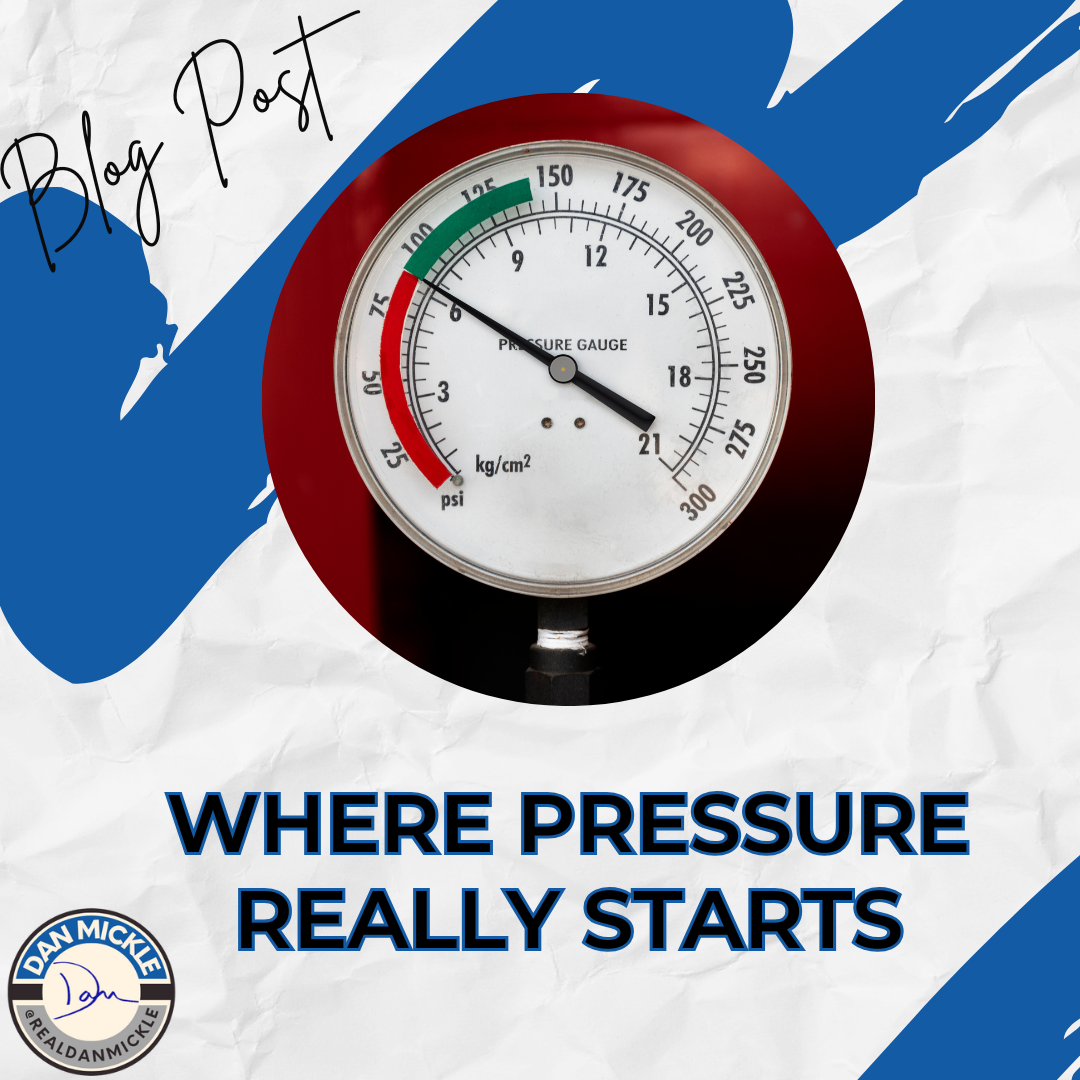
Most people think pressure shows up on game day. Bright lights, a scoreboard glowing, a crowd buzzing, maybe a coach watching closely. But if you really want to understand where pressure really starts, you have to look long before competition or performance ever arrives.
Pressure does not suddenly appear. It builds quietly. Small moments stack on top of each other until pressure feels normal. By the time performance shows up, pressure usually reveals what has already been created.
That is what makes it hard to notice.
Pressure often hides in plain sight. It does not always feel like nerves or panic. Sometimes it looks like over preparing. Other times it shows up as hesitation. In many cases, it sounds like caring too much or trying too hard.
When competition arrives, pressure has already been doing its work.
Language Is Often Where Pressure Really Starts
Language is usually the first place where pressure really starts.
Words like “important,” “must win,” “this matters,” or “don’t mess this up” sound harmless on their own. Coaches want focus. Parents want effort. Athletes want meaning. Repetition, however, gives those words weight.
Everything feels heavy when everything is important.
I have watched athletes play loose and creative in practice, then tight and cautious in matches. Skill did not disappear. Language shifted. Practice became learning. Competition became proving. That single change can turn curiosity into caution.
This is often where pressure really starts, not in the moment itself, but in the meaning attached to the moment long before it arrives.
Systems Quietly Teach Pressure
Systems add the next layer.
Busy schedules. Rankings checked daily. Tryouts framed as judgment days instead of information days. Feedback that shows up mainly after mistakes. None of these systems exist to hurt athletes. Most begin with good intentions.
Even good systems teach lessons.
A system that only highlights outcomes teaches athletes where their worth lives. A system that never pauses teaches that rest does not matter. A system without reflection teaches that mistakes are dangerous.
Systems matter because where pressure really starts often lives inside what gets repeated every day.
Research in sport and performance psychology shows that environments shape stress and motivation more than individual traits. That idea appears repeatedly in work shared by organizations like the American Psychological Association, where context matters as much as mindset.
Identity Turns Pressure Inward
Identity makes pressure heavier.
When athletes believe they are their position, their ranking, or their stats, pressure no longer needs an outside source. It moves inward. Every rep feels like a test of who they are. Every mistake feels personal. Every success feels fragile.
Pressure sticks when identity narrows.
I often ask athletes a simple question that stops them cold. Who are you when you are not performing?
Discomfort with that question usually signals that pressure has already taken root.
I have explored this idea many times on The MentalCast, especially in conversations about philosophy, burnout, and environment. Pressure follows philosophy. What you reward. What you repeat. What you ignore. What you never stop to question.
Routines Can Help or Hurt
Routine is the final layer, and it often gets overlooked.
Good routines create stability. Fragile routines create fear.
When routines turn into rigid rituals, pressure sneaks in. Athletes start believing performance depends on everything going right before they begin. Missing one step can throw off the entire day.
Strong routines support readiness. Flexible routines survive disruption.
Nothing Changed on Game Day
None of this feels dramatic while it happens. No single moment points to the problem. No obvious villain shows up. Pressure grows through accumulation. Language here. Systems there. Identity reinforced. Routine locked in.
Then competition arrives and people ask what changed.
Nothing changed.
Pressure was already there.
Shaping Pressure Earlier
So what do we do with this?
Start by slowing down enough to notice.
Listen to language, not just what gets said, but what gets repeated. Watch for phrases that turn moments into verdicts. Small changes carry more power than big speeches.
Next, audit the system.
Ask what your structure teaches when no one speaks. Look for reset points. Make effort and learning visible. Create room to breathe.
Then, widen identity.
Athletes perform better when they know they are more than performers. Coaches lead better when they remember they are more than results managers. Parents support better when they see the whole human, not just the jersey.
Finally, build resilient routines.
Effective routines prepare without demanding perfection. They support readiness instead of control.
Pressure will always exist. That is not the problem. The real work comes from understanding where pressure really starts and how much of it gets created long before performance ever begins.
When we understand where pressure really starts, we stop fixing athletes at the last second and start shaping environments earlier.
That is where real performance lives.