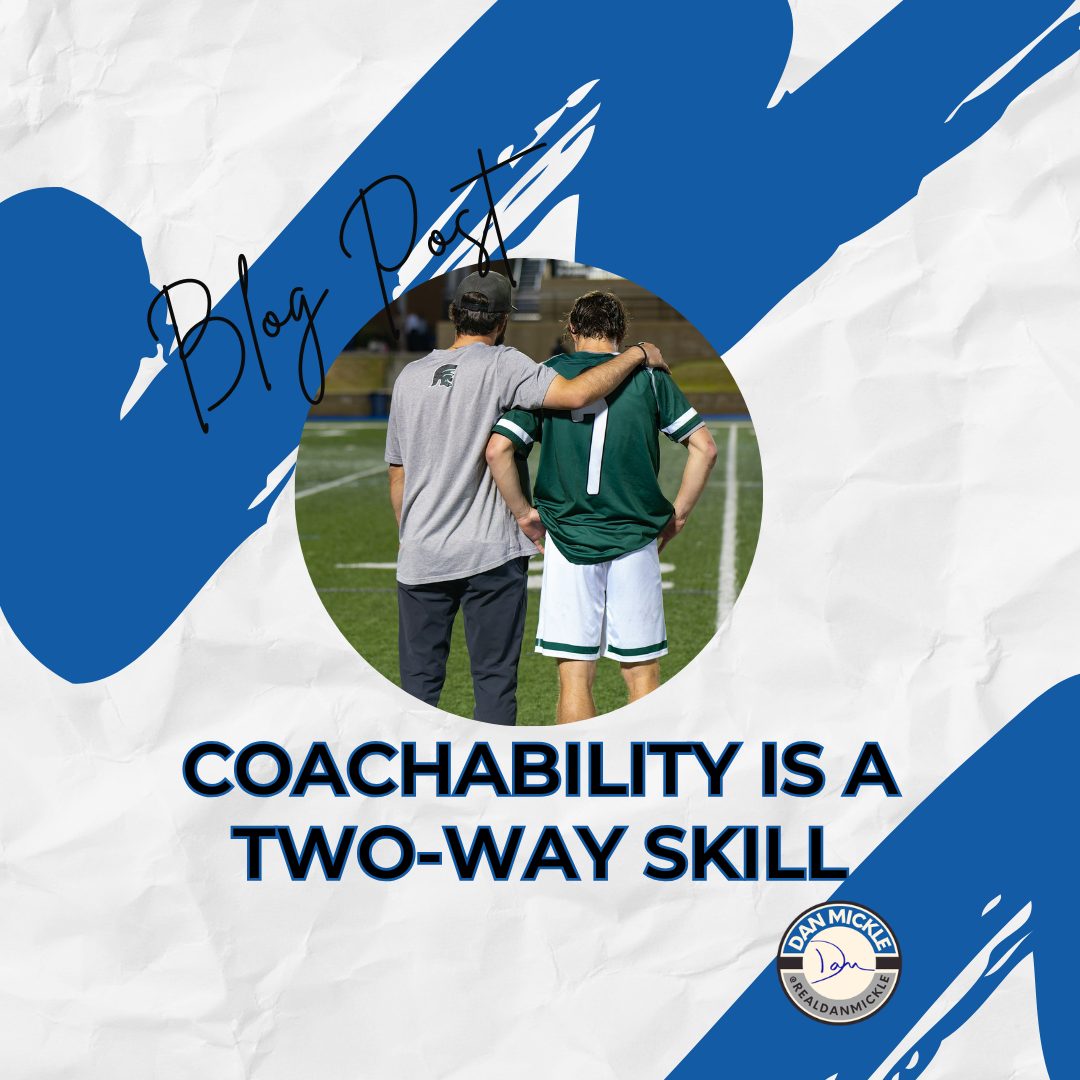
“They just aren’t coachable.” That sentence has probably been said in every sport, at every level, in every decade since one human first tried to teach another human how to throw something more accurately. Sometimes the label is fair.
There are athletes who resist feedback, ignore instruction, blame everyone else, or refuse to engage in the learning process. Those behaviors matter. But I think coaches use the word coachable too quickly. We often define coachability as the athlete’s ability to receive coaching in the exact way we prefer to give it.
That is a very convenient definition for the coach. What if coachability is partly relational? What if an athlete’s response to feedback tells us something not only about the athlete, but also about the way the message is being delivered, the trust in the relationship, the timing, and whether the athlete actually understands what we want?
Receiving Feedback Is a Skill
We treat coachability like a personality trait. You either have it or you do not. I think that is a mistake. Receiving feedback is a skill.
Athletes need to learn how to listen, ask questions, separate correction from identity, try an adjustment, and evaluate whether it worked. Those are behaviors that can be practiced. If an athlete becomes defensive every time we correct them, yelling “stop being defensive” is unlikely to be the breakthrough intervention.
Instead, we can teach a response routine. Listen. Clarify. Choose the next action.
Try it. Report back. That sequence is especially useful for athletes who feel overwhelmed by fast verbal feedback or who need more time to organize what they heard. Neurodivergent athletes may sometimes process correction differently, but the broader principle applies to everyone: if we expect a feedback skill, we should probably teach the feedback skill.
Coaches Have a Role in Coachability Too
The uncomfortable part is that coaches influence how coachable athletes appear. I wrote about empathy in coaching because curiosity changes what we notice. If an athlete consistently shuts down with one coach but responds well to another, we should at least consider the possibility that the difference is not entirely inside the athlete.
Maybe one coach gives a clear cue and lets the athlete try it. Another gives a speech. Maybe one asks what the athlete saw. Another starts with, “Why did you do that?” Maybe one corrects privately.
Another uses the athlete as a public teaching example every time something goes wrong. Those differences matter. USA Volleyball’s resource on coach-athlete communication emphasizes that strong communication grows through dialogue, trust, and adjustment, especially under stress.
That is important because coachability is not simply an athlete opening a door so the coach can pour information inside. It is an interaction.
Do Not Confuse Questions With Resistance
This is a big one. An athlete asks, “Why are we doing it this way?” The coach hears challenge. An athlete says, “That cue does not make sense to me.” The coach hears disrespect. An athlete asks for another example.
The coach hears poor attention. Sometimes the athlete is being difficult. Sometimes the athlete is trying to understand. Some neurodivergent athletes may be especially direct, literal, or persistent when something does not make sense.
The social wrapping around the question may not look the way a coach expects. That does not automatically mean the athlete is rejecting authority. Before assigning motive, answer the question if it is reasonable. If the timing is poor, say, “Good question.
We need to keep moving. Ask me after this drill.” Then actually follow up. That teaches the athlete when questions work without punishing curiosity.
Correction Can Feel Like Identity
Athletes who struggle with perfectionism, anxiety, low confidence, or a long history of feeling misunderstood may hear correction differently than we intend. “Your platform was late” can arrive as “you are bad at passing.” “You missed the read” can arrive as “you let everyone down.” The coach may not have said any of that, but performance environments are full of interpretation.
This does not mean we stop correcting athletes. That would be a strange coaching plan. It means we make the target clear. Correct the behavior, not the person.
“On that rep, your first step went backward. Let’s get the first step forward on the next one.” That gives the athlete something to act on. My post on fighting perfectionism connects here. Athletes who treat every error as a verdict on themselves have a much harder time using feedback. Helping them separate performance from identity can make them more receptive without lowering the standard at all.
Watch the Timing of the Conversation
An athlete can be coachable and still be unavailable for a complex conversation at a particular moment. They just made an error. Their heart rate is high. The crowd is loud.
A teammate is talking. The coach gives a four-part explanation and expects thoughtful reflection in eight seconds. That is not always realistic. Sometimes the best response is a short cue now and a longer conversation later.
The athlete may be much more receptive once they are regulated enough to think instead of simply survive the moment. This is not a neurodivergent exception. It is human physiology with a whistle nearby.
Teach Athletes How to Help You Coach Them
One of the most useful conversations a coach can have is surprisingly simple: “How do you like to receive feedback?” Some athletes want it direct. Some want a question first. Some want video. Some prefer correction away from the group.
Some want the coach to say it once and leave. Others need clarification. You may not be able to honor every preference all the time. That is fine.
The conversation still gives you information. You can also teach athletes how to advocate for themselves. “Can you show me?” “Can you give me one cue?” “Can I try that again before you add anything?” “Can we talk about this after practice?” Those are not signs of weakness.
They are communication tools. In fact, USA Volleyball has made the point that athletes can help coaches understand how they learn best. That idea matters because the best coaching relationship is not one where the athlete passively accepts everything. It is one where both people get better at exchanging useful information.
Coachability Should Produce More Independence
Here is the final test I like: Is the athlete becoming more capable of solving problems without me? If “coachability” means they look at me after every rep waiting for an answer, I may have created compliance instead of learning.
A coachable athlete should gradually notice more, ask better questions, test solutions, and take ownership of adjustments. The coach becomes less of a remote control and more of a guide. That requires trust from both sides.
The athlete has to believe correction is meant to help. The coach has to believe the athlete can think. This week, think about one athlete you have described as hard to coach. Instead of asking only, “Why won’t they listen?” ask a second question: “What happens between my message and their response?” Maybe the conclusion will still be that the athlete needs to improve their behavior.
That is possible. But maybe you will find a communication issue, a timing issue, an unclear expectation, a trust problem, or a learning preference you have never discussed. Coachability is a responsibility for the athlete.
Coaching is a responsibility for the coach. The relationship works better when neither side pretends only one of those matters. Key takeaways: Receiving feedback is a skill that can be taught. Questions are not automatically resistance, timing changes how usable feedback becomes, and coaches influence how coachable athletes appear.
Build communication that leads to athlete independence rather than simple compliance. Until next time, before deciding an athlete is uncoachable, make sure we have actually coached the process of being coached.