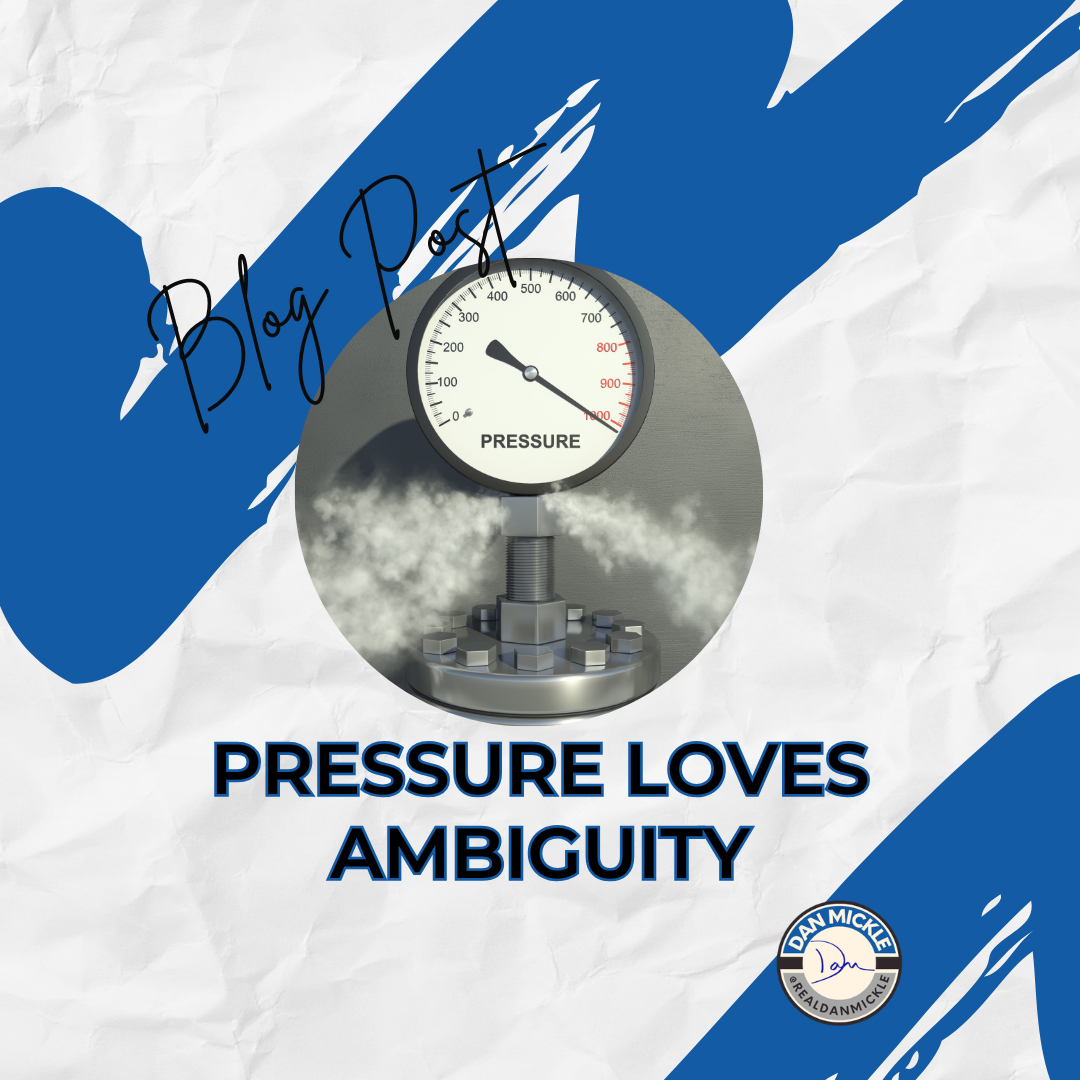
Pressure is strange. It does not always create new problems. More often, it turns the volume up on problems that were already there. A slightly unclear responsibility in practice becomes complete confusion at 23-23.
A cue that worked when everyone was relaxed suddenly becomes useless when the crowd gets loud. A player who could tolerate an ambiguous instruction on Tuesday may freeze when the same instruction arrives in a timeout with 14 people talking at once.
Pressure loves ambiguity. That matters for every athlete. It can matter even more for athletes who already spend extra cognitive energy interpreting language, filtering sensory input, shifting attention, or deciding which information deserves priority. Neurodivergent athletes do not have some separate version of pressure. The environment may simply make unclear information more expensive.
Stress Shrinks the Room
When pressure rises, coaches often respond by adding more information. We talk faster. We explain more. We remind athletes of every possible scenario.
Somewhere in the middle of a timeout, we become a podcast nobody subscribed to. The intention is good. We want athletes prepared. The result may be the opposite.
Under pressure, athletes need clarity about what matters now. They do not need the entire scouting report reinstalled. This connects to the framework I wrote about in When the Wheels Fall Off. In chaotic moments, coaches need a process that helps separate technical, tactical, and environmental problems instead of reacting to everything at once. The same idea applies to communication. What is the one problem we are actually solving?
Replace Motivation With Information
Some of our favorite pressure phrases are basically emotional confetti. “Want it more.” “Dig deep.” “Be aggressive.” “Stay locked in.” “Play our game.” Those phrases can have meaning inside a team if they have been defined.
Without shared meaning, they are mostly noise. If I tell a player to “be aggressive,” what action am I asking for? Serve deeper? Attack a seam?
Take the first available shot? Move earlier? Communicate louder? Pressure is a terrible time to discover that coach and athlete have different definitions.
USA Volleyball’s coach-athlete communication guidance emphasizes building communication standards before stressful moments arrive. That is the important part. We should not invent the language of pressure while we are already in pressure. Create cue words in practice. Define them. Rehearse them. Make sure athletes know what action the cue should trigger.
One Cue Can Carry a Lot
A good pressure cue is short because the meaning was built earlier. “High hands” can carry weeks of attacking work. “Early eyes” can carry defensive training. “Next job” can carry an entire reset process.
The words are small because the learning behind them is large. This is one reason concise communication can be particularly useful for some neurodivergent athletes. The athlete does not have to sort through a paragraph while also processing noise, movement, emotion, and game information.
Still, short does not automatically mean clear. “Focus” is short. It is also spectacularly vague. The cue has to point somewhere.
My post More Than Words explored the idea that athletes may need visual, physical, or other forms of communication rather than more talking. In pressure moments, a familiar hand signal, whiteboard image, or simple positional reference may work better than a speech.
Pressure Exposes Unwritten Rules
Ambiguity is not only technical. Who talks in a timeout? Who makes the final decision? Can a freshman challenge a coverage call?
What happens if a player does not understand the instruction? Is it acceptable to ask the coach to repeat something? Teams often learn these rules by watching, not by being taught. That works until stress makes the social environment harder to read.
A neurodivergent athlete who already finds implied hierarchy difficult may become even less likely to ask a question in a high-pressure moment. An anxious athlete may nod because they do not want to look confused.
A younger athlete may stay silent because everyone else seems to understand. Then the athlete runs onto the court with a question they were too afraid to ask. That is a team-design problem. Make it normal to clarify.
“If you are unsure, ask now.” Better yet, ask a player to repeat the assignment in their own words. Not as a quiz. As a check that the message survived the timeout.
Coach the Environment Before the Moment
We cannot remove pressure. Nor should we. Competition is supposed to matter. We can train the environment.
Run timeouts in practice with the same structure you will use in matches. Decide where athletes look. Decide who speaks first. Keep the order consistent.
Practice delivering one or two cues while background noise is present. Occasionally rehearse with time pressure. The point is not to make practice theatrical. The point is to make the communication process familiar enough that athletes have fewer things to decode when the game gets loud.
This is also where coach regulation matters. I wrote about staying calm as a coach because athletes read us too. If our language becomes frantic, our body becomes frantic, and our volume doubles, the athletes now have another signal to interpret: apparently something is very wrong. Sometimes calm is not a personality trait. It is instructional design.
Do Not Add Pressure to Pressure
There is a coaching habit I have become increasingly skeptical of: intentionally making communication less clear because “they need to figure it out under pressure.” Athletes absolutely need to solve problems. They need uncertainty. They need to read opponents.
They need to adapt when plans fail. But the uncertainty should come from the performance problem, not from the coach refusing to explain the task. If I want a setter to learn how to choose against a changing block, I should create variable blocking.
If I want a quarterback to read coverage, I should vary coverage. If I want a volleyball team to handle end-game pressure, I should manipulate scoring and consequences. I do not need to make my own instructions confusing to create challenge. That is like training someone to drive in traffic by smearing the windshield.
Build a Pressure Language
This week, make a list of the five phrases your staff uses most during stressful moments. “Next ball.” “Be aggressive.” “Settle down.” “Do your job.” “Communicate.” Whatever they are. Then ask your athletes what each phrase means.
You may learn something uncomfortable. If the answers are all over the place, tighten the language. Replace vague motivation with a clear action. Define the phrase in practice.
Use it consistently. Let athletes tell you which cues actually help them. The goal is not to make athletes dependent on coach language. The goal is to make the language efficient enough that it supports action instead of competing with it.
Pressure will always make the moment louder. Our job is not to out-yell it. Our job is to make the next useful action easier to find. Key takeaways: Pressure amplifies unclear communication.
Build cue language before stressful moments, replace vague motivational phrases with usable actions, rehearse timeout and communication routines, and make clarification normal. Let the performance problem create the challenge, not confusing coaching. Until next time, when the moment gets loud, clarity should get quieter and sharper.